
Blog
Susan Berliner is the author of seven supernatural thrillers ("DUST," "Peachwood Lake," "The Disappearance," "Corsonia," "After the Bubbles," "Soldier Girl," "The Resolve"); three short story collections ("The Sea Crystal and Other Weird Tales," "George's Mother and Other Weird Stories," "Crash Effect and Other Weird Stories"); a memoir ("Doing the Write Thing"); and a children's picture book ("Windsoar, the Flying Car"). This page contains blog entries from January 1, 2012 - December 30, 2012.
Writing resolutions - December 30, 2012
My short term resolution is to finish making changes to the first draft of The Touchers, my doomsday novel, so I can return to writing the second part of the book. As I've mentioned before, I'd much rather write than edit; it's a lot more fun!
Family obligations have made it more challenging to find time each day to do my writing and editing, but that's still a poor excuse. My feeling is there's always time for writing--even if it's just a short period, thirty minutes or less. Now I've got to follow my own advice and make sure I find the time.
My long term resolutions are twofold: to get back to editing Corsonia, my mind control novel that's been sitting on the shelf for several months and to finish editing my husband's humorous memoir so it can be ready for publication sometime in late 2013.
Happy New Year!
* * *
Cover creation - December 26, 2012
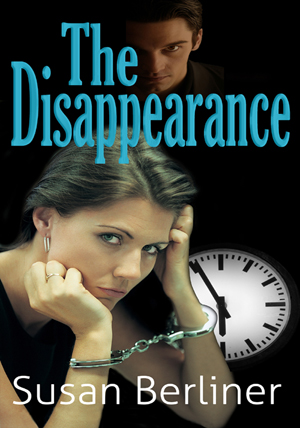
In a recent interview, I was asked how much influence I had in the cover design of The Disappearance. My answer? I had a huge influence--so I'll take either the credit or the blame. The artist, Book Graphics, did a wonderful job, listening to me and then incorporating all my ideas.
I wanted a photo of an unhappy young attractive woman in handcuffs for the heroine, Jillian Keating. You'd think that would be easy to find, but it took many hours because nearly all the pictures of handcuffed women showed them dressed either as half nude phony police officers smiling playfully or as sex kittens wearing pink furry cuffs.
I also chose the photos for the other elements of the cover: a menacing man for the villain, Ryan Cornell (much easier to find!) and the clock in the background, which represents time travel. Then the artist skillfully positioned the characters so that the villain is looming in the background.
I love the completed cover and I hope readers do too!
Virtual tour leftover - December 20, 2012
My virtual tour ended last Friday and, since one of my guest posts never appeared, my plan was to publish it here. However, today I discovered that the article did in fact run belatedly this past Monday (kind of like cancelling an appearance and rescheduling it--but not telling anyone about the change).
It's called "Ten Things You Probably Don't Know About The Disappearance"--short tidbits about my new time travel thriller. I hope you're curious enough to check it out.
* * *
The reviews are in - December 16, 2012
If you've been following this blog, you know that for the first two weeks of December, I've been on a virtual book tour for my new time travel thriller, The Disappearance. During that time, I traveled around the Internet giving interviews, guest blogging, and having the novel reviewed. If you'd like to check out some of my virtual appearances, the full itinerary (with links) is posted on Happenings.
To me, the reviews were the most exciting--and scariest--part of my tour because I had no idea of what would happen. We authors love our books; we've created them and they are our children. I think The Disappearance is a suspense-filled, fun novel--but will these four strangers agree? Will they like my book? Will they recommend it?
The votes are in and The Disappearance received excellent reviews. To read clips of what these reviewers--and other readers--said, please click here.
* * *
Editing notes - December 11, 2012
The great thing about being on a virtual tour is that it's virtual, allowing me to really multi-task. I can be in two places at the same time: on tour on the Internet and at home, editing my doomsday novel, The Touchers.
Editing is a tedious process. I've got to sift through four pages of notes to myself and check off each correction, one by one. Here's some of what I accomplished today:
* I finally read through the fire hydrant information I've avoided looking at for nearly a year. I shouldn't have procrastinated; the fixes were much easier than I'd thought.
* I corrected references to a history book and to a calendar.
* I added Muffles the dog to a chapter in which I'd forgotten to include him. That's the trouble with having a pet in a story like this. I needed him in a few places, but otherwise he's not integral to the plot. However, since he's here, I can't just forget about him.
* * *
Publishing in today's world - December 7, 2012
On my virtual book tour, one interview this week asked for my thoughts on the publishing world today. To me, it seems obvious that traditional publishing is declining and bookstores--especially independent ones--are an endangered species. In fact, this afternoon at my book signing in Drum Hill in Peekskill, NY, a former publicist told me she had recently learned that all the mystery book stores in Manhattan had closed. I'm not surprised, just sad.
I love reading printed books. I love the look, the feel, the smell. It's a sensory experience one can't get from electronic books. But most paper books will probably be gone in a few decades (except maybe children's books because parents still like their kids to experience printed pages). Ebooks seem to be the reading choice of many of today's readers. My daughter wants to get me an ereader for the holidays. It'll be convenient because I read in bed before going to sleep at night. But I don't think I'll like it.
* * *
Touring the virtual way - December 3, 2012
For the next two weeks, I'm on a virtual book tour to promote my new time travel thriller, The Disappearance. Each weekday through December 14, I'll be on various websites giving interviews, writing guest posts, and having The Disappearance reviewed.
Of course, I'd love to be traveling the country on an in-person tour, but that's very costly. When my first novel, DUST, was published in 2009, I filled out a marketing survey and my favorite question related to the amount of money I'd be willing to spend to promote my book. Next to the $25,000 figure was the following sentence: "My dream is to sit on Oprah's couch!"
Since I don't have that kind of budget for publicity, I've opted for a virtual tour. Although I'm still going to be "visiting" various places to promote The Disappearance, my tour will be done entirely on the Internet. For a schedule of tour stops, please see the Happenings page--and I hope you'll attend my virtual appearances!
* * *
Writing ritual - November 29, 2012
In an online interview, I was asked if I have any "rituals" when finishing my work. I realized that I do perform a kind of ritual after completing the first draft of a novel: I make lists--lots of them.
Here's why: When I'm creating a novel, I don't go back each day and reread everything I've already written for two reasons--it takes too long and it interferes with the flow of my writing. As a result, it's easy for me to forget some details--eye color, car model, street name, etc. Therefore, when I'm ready to edit a manuscript, I list and describe all the important elements in the book--characters, settings, events, and anything specific to that particular novel.
For example, in The Disappearance, time travel dates are significant (and difficult to keep track of) so I listed them. In The Touchers, the doomsday book I'm currently working on, each chapter has a title in addition to a number so I've made a list of chapter names.
When I edit a novel, I always consult my lists to make sure every detail is correct.
* * *
Changes are a-coming - November 25, 2012
I've finally finished making minor corrections on my initial reread of the first draft of part one of The Touchers, my doomsday novel. Here's what I still have to do:
* Tackle four single-spaced pages of potential changes.
I scribbled many notes to myself as I was writing his book. Now I've got to read all the comments and decide what to do with them.
* Map out the neighborhood and name all the streets.
I didn't want to stop writing the first draft to name roads so I have characters driving through many unnamed streets. Now I have to create an accurate road map and fill in all the blanks.
* Research fire hydrants and more.
I don't like doing research, but I will do it now.
* Flesh out the backgrounds of several minor characters.
This is another instance of forging ahead with my writing and not taking the time to work out some family relationships.
* Check the chapter headings.
My other novels just have numbered chapters. However, in The Touchers, each chapter is titled as well as numbered. (I'm not sure why; it just seemed right.) I may have some repeated headings.
Then, after I make all these changes, I can start writing Part 2 of this epic.
* * *
Thoughts of thanks - November 21, 2012
The Thanksgiving holiday got me thinking about what I, as a novelist, am thankful for. Here's a short list:
1. I'm thankful for my computer word processing program.
I remember (not fondly!) the days of manual typewriters: my Royal portable--jammed keys, horrible carbon paper (with ink that got all over my fingers), correction tape, and torn ribbons. Yucch! Every revision was a messy and lengthy process. I'm not a technology lover, but I do love writing--and editing--on the computer. I don't even have to count words!
2. I'm thankful for my author friends.
Writing is such a solitary, isolated profession. You sit by yourself in a room in deep thought, sometimes for many hours. It's not exactly a sociable job. As a result, when I'm not writing, I like getting together with other writers who've had similar experiences.
3. I'm thankful for positive feedback from people who have read my novels.
It's satisfying to hear readers tell me they've enjoyed my novels. That reinforces my sometimes shaky ego and energizes me to keep writing.
What are you thankful for? Happy Thanksgiving, everyone!
* * *
The crumbling cupcake - November 17, 2011
When I heard the news a couple of days ago that Hostess Brands was going out of business, I got pretty upset. Of course I'm saddened for all the jobs that are being lost and for the demise of iconic foods like Twinkies and Wonder Bread. But my reaction was for more selfish reasons: Hostess CupCakes are featured in my not-yet published novel, Corsonia. My villainess is addicted to them.
I spent a considerable amount of time deciding on a suitable pastry for this evil woman, finally choosing Hostess CupCakes, which will now either cease to exist or be sold to another company. Whatever happens will take at least a year and, even if the product survives, it might not be called "Hostess CupCakes."
Unless I want to set my novel before November, 2012, I have to change the character's food fetish. I'd really pictured her devouring those Hostess CupCakes, but I guess she can munch on Mallomars instead.
* * *
Weird things happen - November 13, 2012
This evening, I was a guest on Janice Lee Odom's "Featuring the Arts" radio show. Since my novels are supernatural thrillers, one of the questions Janice asked me was: "Have you ever experienced anything supernatural?"
"Yes," I replied.
Here's the true story: A couple of years ago, I had a book signing at the Tazza Cafe in Somers, NY and, when I arrived, the power went out. About two hours later, the electricity was still off when the cafe owner escorted me to the restroom in the back. Out of habit, I flicked the light switch, and, at that exact moment, the electricity returned--and the light went on. The owner told me he got the goose bumps and he even asked me if I had paranormal abilities. (I thought maybe I could be a new super heroine--Electric Woman?--until I found out that heavy winds had knocked down a nearby power line.)
Then a few months ago, I had another weird, although not quite supernatural, experience. At a book signing in Ossining, we had a tornado warning and all vendors had to go inside the building, a facility for seniors. Inside, I sold a copy of DUST--my novel about a mini-tornado--to a 100-year-old lady named Dorothy, the heroine's name in The Wizard of Oz, another tornado story.
As the saying goes, truth is stranger than fiction!
* * *
The neverending novel - November 9, 2012
As I reread The Touchers, my end-of-the-world novel, I keep wondering whether this already 80,000-word story needs a sequel or just a Part 2. I thought the book was ending, but my characters have decided that it's not. Since this has never happened to me before--none of my other characters demanded sequels--I posed this question to writers on Facebook: "How do you decide whether to break a novel into two parts or write a sequel?"
I got lots of helpful responses. Several authors warned me not to end the story without a satisfactory resolution or break it before a major cliffhanger or "your audience will be pissed." But that's not the case; the major conflict has been resolved. However, new challenges await my heroine.
As for word count, most writers told me not to worry about the numbers. "Let the story end where it ends," one woman advised. "Just write the story, the end will come when it's ready, not when you want it to :)," another remarked. I already know that. If it were up to me, the book would already be done!
After I reread this first draft, I'm going to continue writing The Touchers. Will it need a sequel or just a Part 2? I won't know the answer until the story finally ends.
* * *
Routine matters - November 5, 2012
I'm back into my daily writing/editing routine and it feels good. Today, I reread several chapters of the first draft of The Touchers, my doomsday novel. It's lots of fun--I'm enjoying the story because it's so new; I haven't read it a zillion times yet. Also, I'm not doing heavy editing in this round. Eventually, however, reading the manuscript will be tedious and I'll have the words almost memorized.
I'm finding some mistakes and inconsistencies, but mostly I'm seeing gaps--missing street names plus tech and medical details that I've still got to research. But, to paraphrase Scarlett O'Hara, "I'll think about those problems tomorrow (e.g. next round of editing)."
* * *
Tech-Know - November 1, 2012
Like millions of people on the East Coast, I've had no power since Monday night due to the wrath of Hurricane Sandy. Shortly before I lost electricity, I received the audio file of last Friday's radio interview and attempted to put it on my website. Usually the computer and I are not at all compatible, but fortunately I managed to get it right on my first try. (Of course, I did watch the "How to Insert an MP3 File on Your Website" video three times.)
If you'd like to listen to the 7-minute interview about The Disappearance, my new time travel thriller, click here and scroll past the upcoming events. It was "live" radio so I hope I sounded okay.
I'll be back online eventually. In the meanwhile, to everyone affected by Hurricane Sandy, stay warm and safe!
* * *
Rereading the manuscript - October 25, 2012
Now that I'm surprisingly finished with the first draft of my doomsday novel, The Touchers (see October 21 post below), I've begun the daunting task of rereading and revising. So far, I've read thirteen chapters, roughly one-third of the novel, and made some minor changes. I haven't yet tackled the major issues (I have four pages of notes), including necessary research that I put aside to forge ahead with the action.
In this round, I'm mostly trying to get my facts straight, especially the overall time frame--when each event takes place. Of course, I've already found many mistakes--including the misspelling of one of my main character's names. Somehow, during the course of my writing, Cyndy Louise morphed into Cyndi Louise. At least that correction is an easy fix.
* * *
Characters in charge--again! - October 21, 2012
I'm back into my writing routine, so this morning I wrote a scene in my doomsday novel, The Touchers. But after I finished, I looked at what I had written in amazement. Somehow, I had abruptly ended the novel (the first draft, anyway).
There wasn't even going to be an Epilogue wrapping up all the loose ends and details as I'd done in my previous four books. Instead, my characters had decided on something else--a sequel!
"No!" I felt like shouting. "It's enough! I don't want to continue this story!"
But my characters do. So here's my plan: I'll reread the first draft--make zillions of corrections, revisions, and additions. And then I'll see if I have to listen to my characters and write a second book about them. Or maybe I can find a neat way to wrap up this novel. Frankly, I'd prefer the latter choice.
* * *
Following my own advice - October 17, 2012
I had an interview this evening and the reporter asked me a question I've answered many times before: What advice do you have for beginning authors?
My response is always the same: Make time for writing. Treat writing as a job and schedule a specific time each day to write. It doesn't have to be eight hours like full-time novelists. It can be just an hour each morning like I do--or even 30 or 15 minutes. But whatever time you choose--do it! If you stick to your writing routine, eventually you'll produce a novel. I know because I've published three.
Here's my problem: Over the last week, I haven't followed my own advice. With the publication of The Disappearance, my time travel thriller, I've been so involved in launching the book that I haven't been able to do much work on The Touchers, the doomsday novel I'm currently writing.
With the exception of Saturday when I have an all-day event, I intend to get back into my morning writing routine. I don't want to be "too busy" to write.
* * *
The Disappearance is here! - October 13, 2012
Finally, after nearly two years of work, The Disappearance has been published, both as a paperback and as a Kindle e-Book. The amount of work that goes into producing a novel involves much more than just the writing--there's research, revising, editing, and proofing. But now the novel is finally here (although not physically. I haven't yet received my book order).
I found it a little easier publishing The Disappearance than Peachwood Lake, which debuted last year. At that time, I messed up entering some of the data, pressed a button prematurely (computers are not my strong point!), and the formatter had problems getting the book to look good on Kindle. This time, I did a better job entering the data, and although I still had a problem with Kindle, it was my doing. I wanted the opening reviews to have the reviewer's name flush right on the same line as the quote. Kindle didn't like my idea, apparently because it involved two commands on the same line. I guess you can't be fancy with e-Books.
It's been a long journey for me. But now the next step is up to you, the reader. I need you to read the novel and let me know what you think of it. The online links for The Disappearance are on the bottom of the Order page. I'm waiting to hear from you!
* * *
The Disappearance is (almost) here - October 9, 2012
My new book has been born! I've seen the "baby" (a paperback proof) and read it for the zillionth (and last!) time. That means the print version of The Disappearance will be available online at Amazon and Barnes & Noble, and for order at retail book stores, as soon as it's listed everywhere. The e-Book version will also be on Kindle for those who prefer the electronic reading experience.
Me? I'll be waiting anxiously for readers' opinions of this novel. Hopefully, people will enjoy the time travel/sting plot. I love time travel stories and had fun writing this one. The book is categorized as "Romance/Time Travel," but that's just because it was the only available "time travel" listing. The Disappearance is much more of a time travel thriller. So prepare to be thrilled!
* * *
Creepy contest - October 5, 2012
We're into October, which to me means two things: fall and Halloween. Autumn is an interesting season on the East Coast, with beautiful foliage followed by falling leaves. But Halloween (especially for an author of supernatural thrillers) is spooky good fun. And you can have lots of fun--and win great prizes-- in the huge Halloween web scavenger hunt that I'm participating in with 100 other authors. It's also a way for people who love to read to discover many new novelists.
In the contest, I'm giving away a $25 gift card to Barnes & Noble. All you have to do is fill in two words about Peachwood Lake from the description on my Home page. Go to Night Owl Reviews, complete the required "Fill in the Blanks," then scroll down to "Susan Berliner," and write the two missing words. Good luck, everyone!
 http://www.nightowlreviews.com/nor/pages/FullMoonDetails.aspx
* * *
A few days ago, a Facebook acquaintance asked me about co-authoring, explaining he and a friend wanted to write a book together, but the friend didn't seem to understand what to do. "It almost seems as if he has taken my ideas and is making them into his own book," he said. "I'm a little lost about how to make co-authoring work." He added that he had written "a little," but his friend hadn't contributed anything.
This was my response: "The only person I've every co-authored with was my husband--and we still work together on educational projects--[in fact, we just finished an assignment today] so I'm not an expert on this topic. But before you get much further involved in this project, I suggest you talk to your friend and draw up some guidelines: What do both of you want this book to be? What will each of you be writing? I think you have to outline your project and both be clear about your responsibilities."
Thinking about co-authoring now, I would also recommend the friends draw up a simple contract to protect each of them. I did caution that, if they couldn't reach an agreement, they had better stop the project before it destroyed their friendship.
* * *
Romancing the novel - September 27, 2012
Recently, an author friend who has written a historical romance told me she's working on another novel--again a romance, but in a modern urban setting. "It doesn't matter where and when the story takes place," she told me. "All romances are essentially the same: boy meets girl, boy and girl have problems, boy gets girl."
I don't write romance novels so I had never analyzed the genre, but I think my friend is right. In a romance, the characters are attracted to each other, their relationship becomes difficult, and, in the end, their issues are resolved and they live happily ever after. (Or in the sad Romeo and Juliet or Love Story-like ending, one character dies and the couple doesn't wind up together. However, before the tragic conclusion, the duo still manages to overcome their obstacles and find true love.)
The only differences in a modern romance would be, instead of limiting the options to boy meets girl, today you can have boy meets boy or girl meets girl--or even girl meets vampire, werewolf, troll, etc. But other than the greater selection of potential lovers, the story description remains the same.
* * *
Finding the "write" time - September 23, 2012
At two book signing events this past weekend, I've had several people congratulate me for publishing novels and then wistfully tell me that they've "tried" to write books, but couldn't do it. One woman said she had written 100 pages and then stopped. "I just can't find the time," another woman told me.
My comment to wanna-be writers is always the same: "You have to find the time." It doesn't matter how short a period you designate for your writing time--even fifteen minutes a day will work--but you've got to be disciplined and stick to whatever schedule you establish for yourself. I only write for about an hour each morning, but eventually those 200 to 500 word scenes turn into chapters and then into full-length books.
You don't have to be a full-time writer, locking yourself in a room for 12 hours each day to produce a novel. But you do have to treat writing like a "job" and set aside a set time to do it. So if you want to write, don't procrastinate--just write!
* * *
Phone books - September 19, 2012
With the rise of cell phones, what should cities do with their soon-to-be obsolete public phone booths? According to a recent New York Times story, architectural designer, John H. Locke, is converting a few of New York City's 13,000 sidewalk pay phones into lending libraries. He has devised a bookshelving unit that fits inside the phone booths and publishing houses, book stores, and neighbors have offered to supply him with books. (He leaves the phones intact since some calls--especially 911 emergency calls--are still made from these kiosks.)
It's an interesting way to get books out on the streets (literally!) and maybe encourage some people to read--without having to go to libraries, bookstores, or even online to Amazon. In the article, some passersby browsed but didn't take any books, one man took a book, but most people just ignored the refurbished structure. However, this is New York City: As the reporter watched, four men entered the phone booth, emptied the shelves, and left with all the books. Hopefully, that's not typical of what will happen to other converted "libraries" because these book booths seem like a worthwhile endeavor.
* * *
Spooky surprise - September 15, 2012
This morning when I wrote a scene in my doomsday novel, The Touchers, the characters noticed something strange about the appearance of the villain, a transformed human who's been trying to kill them. I had no knowledge of this discovery, but Erin, my teen heroine, and her brother, Danny, took over the action and I just transcribed what they said.
I'm still amazed at how often I sit down to write a scene in a novel, not knowing what's going to happen, and then the words magically appear on the page like someone else is typing them. Good thing I'm creating supernatural fiction because it's really spooky the way this weird stuff happens!
* * *
Weird weather - September 11, 2012
My first novel, DUST, is based on real weather phenomena--dust devils, which are miniature tornados. Thus, it makes sense that during my YIKES! & TYKES book signing last Saturday at Bethel, a facility for seniors in Ossining, NY, I was involved in a weird-weather situation. Although the day started out with dark clouds, followed by rain, the event was held outdoors. As a result, Linda Griffin, author of My Child Won't Listen...and other early childhood problems, and I weren't able to display our books until we were relocated under a protected porch.
Then, a few minutes before noon, we heard a siren blast. We looked for the source of the noise and discovered it was coming from Linda's phone. It turned out to be a "Tornado Warning" for Ossining, instructing us to "Seek shelter indoors immediately." So that's what we did. We packed up our books and signs and went into the building.
Several residents of Bethel joined us. One lady asked to see my novels and then decided to purchase DUST. It was all very strange: I sold a book about a whirlwind to Dorothy during a tornado warning. (Wizard of Oz, anyone?) And my Dorothy is 100 years young. (For a photo, go to Happenings.)
* * *
Senior students - September 7, 2012
I was asked to teach a 5-part creative writing course to residents of the Drum Hill facility for seniors in Peekskill, NY and "school" began on Wednesday. The last (and only) time I taught was more than forty years ago in the Bronx and my students then were second graders who couldn't even read--so this was quite a change.
Nearly twenty men and women attended the first class and they were wonderful! No discipline problems--and these folks were both enthusiastic and talented. I focused on descriptive writing, offered some suggestions, elicited types of settings, and had the students write short descriptions about places of their choosing.
Several men and women volunteered to read their work aloud and if those were any indication of the talent level of this class, then these seniors are fantastically gifted. The goal at the end of the course is for each student to write a short story; I can't wait to see the final results! For pictures of my class, see Happenings.
* * *
Contest words - September 3, 2012
I love creative contests. In fact, for 20 years I produced them for the Yorktown (NY) PennySaver, a large chain of shopping guides. Since becoming a novelist, I've continued to create contests here on the website relating to my books.
My haiku contest just ended (results will be announced soon) and now I'm participating in a huge Halloween web scavenger hunt with about 100 other authors. And the contest is a lot of fun. It's also a way for readers to discover many novelists--and win oodles of great prizes.
One reader has already mentioned that he really enjoyed this word scavenger hunt. Hope you'll check it out!

Birthing a book - August 30, 2012
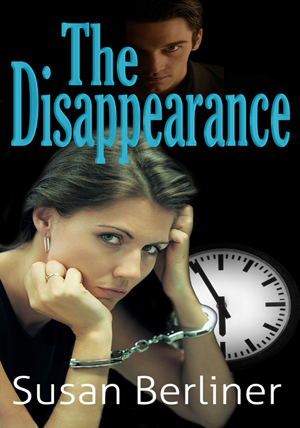
My baby is almost ready to be born. I hope to give birth to The Disappearance, my time travel thriller, in October. It's been a long and difficult process involving a lot of work--countless revisions, readings, and proofings. But now the finish line is clearly in sight. The print version of the novel has been formatted and the front cover has just been completed.
Producing a novel is an exhilarating experience--much like giving birth to a child--and I can't wait to turn the pages of my newly-printed book. Here's a preview of the cover. What do you think?
* * *
Death wish - August 26, 2012
This morning, like usual, I wrote a scene in The Touchers, my end-of-the-world novel. However, after I'd finished, I reread the words I had written and erased nearly all of them.
Why? I realized the scene was boring. Since nothing much happened, the incident served no purpose. Then I had an idea: What if the guy driving the car dies? That would certainly energize the action. So I rewrote the entire scene and, this time, the character (just an "extra" like in the movies--a "walk-on" without even a name) encounters a killer. Much better!
* * *
Speed writing - August 22, 2012
Today, while talking to the artist who's designing the cover of my time travel novel, The Disappearance, I mentioned the book will be published this fall.
"Just make sure it comes out before NaNoWriMo," she urged.
"Huh?" I said.
She was surprised I had never heard of National Novel Writing Month, which takes place each November. Apparently, it's an international happening, with novelists from all over the world joining together to write books in just that one month. Then the participants publish their works in time for the holiday season.
"Maybe it's not popular where I live," I suggested.
"It's popular everywhere," she replied.
So I checked and the artist was right: White Plains--the city just 30 minutes from where I live--has 362 members.
In 2011, the NaNoWriMo participants produced more than 3 billion words. It sounds like quite an event--but I don't want to write so quickly. I like my slow and steady pace. I just have to be fast enough to publish The Disappearance before November.
* * *
The right word - August 18, 2012
I woke up early this morning and couldn't go back to sleep. I kept thinking about the last two sentences of the back cover description of my time travel novel, The Disappearance, which will be published this fall. Something about those lines has been bothering me for weeks. I return to the sentences so often that I've memorized them. Therefore, when I couldn't sleep, I churned the words around in my head, trying to make improvements.
Finally, at about 6 am, I got an idea, turned on a flashlight, and scribbled a short phrase. That's all it was--only four words, which I substituted in the final sentence of the back cover description. But now I like the way it reads.
This experience reminds me of a story about Truman Capote, who was asked by his writer friend, Robert Ruark, how many words he had written that day.
"Just one," Capote said. "But it was the right word."
* * *
Reviewing the situation - August 14, 2012
I've been moving forward, writing a scene nearly each day in my doomsday novel, The Touchers. But even though I know what's happened thus far in the story, I don't remember every detail and, apparently, I've forgotten some pretty important ones. Recently, I realized I had unintentionally injured the same character twice--and I'm not sure I want that to happen. Also, I still feel the pace of the action is dragging somewhat. Since I'm supposed to be writing a thriller, that's not good.
What does all this mean? I have to backtrack and reread the 68,000 words I've written. I'd much rather keep writing the first draft, but now I really don't have a choice. I have to make sure I know what my characters are doing, fix major problems, and add juice to the recent scenes. After that, I should be able to forge ahead again.
* * *
The write course - August 10, 2012
I've been asked to teach a creative writing course at a facility for seniors. The last time I taught--a zillion years ago--my students were second graders, so this is a brand new experience for me.
I told the recreation director that I want this 5-session course to be completely upbeat and non-judgmental, more of a workshop than a class, with only positive reinforcement. The aim is for the participants to write short stories and I have a secret resource: Thirty years ago, my husband and I co-authored a 6-book series for middle- and high school students called Written Expression: A Specific Skills Program, published by Hammond, Inc. Each book culminated in a writing project; the orange book focused on creating a short story.
It's going to be awesome to use my own material for this creative writing course! I start in September. Wish me luck!
* * *
Call for action - August 6, 2012
Yesterday, I finished writing a chapter in The Touchers, my doomsday novel, so I thought the chapter was done. But it wasn't. At some point during the day, I realized the closing action wasn't exciting enough. I had ended the chapter with a whimper, not with a bang. A character in great danger had squirmed out of trouble much too quickly and easily. Something more threatening was needed.
So today I returned to the final scene of the chapter and revised the ending. Instead of the character easily escaping the threat, I added more suspense with a car collision. Although my characters do determine the action, sometimes they're not dramatic enough. And, as the author, I make the ultimate decision. Now I'm done here and ready to move forward again.
* * *
Whose story is this anyway? - August 2, 2012
I'm prepared for shifts in my novels as characters say and do the unexpected. However, this week I was surprised by a new character who popped into my story much like an uninvited party guest.
I didn't know Kyle was going to join the action. In fact, I had anticipated a completely different set of events. But that's not what happened; Kyle happened. Then, today, this little boy took over the scene I was writing--again not doing at all what I had expected.
This is the fun part of being a novelist--the uncertainty (and suspense) of never knowing the direction a story will take. And, in this case, I didn't even know Kyle was attending my party.
* * *
Filling in the gaps - July 29, 2012
I've only had writer's block once. It happened when I was working on Peachwood Lake and couldn't figure out what my characters were doing on a particular day. For some reason, they refused to cooperate and perform for me. But instead of agonizing about my predicament, I left those scenes out and forged ahead with my writing. A few days later, I realized what my characters had been doing during that period of time and went back and filled in the missing scenes.
Something similar just happened with The Touchers, the end-of-the-world novel I'm writing. On July 21, I blogged about my problem with Muffles, the dog. I had left him out of the action because I couldn't decide where he was supposed to be. But yesterday, the answer finally occurred to me and I revised the previous pages, adding the new details about Muffles.
This is another example of not forcing the issue. Instead of obsessing with plot problems, I find it best to continue writing and wait for the muse to hit. Even if it takes a while, I think it's a much better tactic than straining to write something that's just not there.
* * *
Doomsday: personal style - July 25, 2012
I just finished reading The Age of Miracles by Karen Thompson Walker. I had been looking forward to this new novel for one main reason: It's an end-of-the-world tale, told in the first-person by a young girl. If you follow this blog, you know I'm currently writing an end-of-the-world novel, also told in the first-person by a young girl.
Of course, these two books are quite different. The narrator of Walker's book is 11; mine is 15. Walker's doomsday premise (inspired by a newspaper article, like my thrillers, DUST and Peachwood Lake) is a slowing rotation of the Earth that plays havoc with days and nights, throwing the planet out of whack, and gradually destroying everything. In fact, I thought Walker's novel could have been titled "The Slowing," which is what the process is called. I won't reveal the premise of my disaster, but it happens quickly and dramatically in the very beginning of the book, not gradually.
Since my doomsday story isn't finished, I recommend The Age of Miracles. It's an excellent novel, well-written and entertaining--although, as you can surmise from this post, it's not exactly a lot of laughs.
* * *
Where is Muffles? - July 21, 2012
I have pet dog characters in two of my novels: Benny in DUST and Muffles in The Touchers, the book I'm currently writing. While Benny plays an integral role in DUST, Muffles has a less important part in my doomsday novel. The dog is needed in the beginning of the book, but not so much afterward.
I'm writing Chapter 27 of The Touchers now and I'm not sure where the dog is. That's the trouble with including pets in the action--once they're part of the story, they have to be accounted for. I can't just forget about Muffles, unless I kill him off, and I don't want to do that.
My main characters have just returned from an arduous adventure and I've got to decide what they did with the dog. Did they leave him alone in the house or bring him to a next-door neighbor (not so easy to do in this book)? I've made a note to myself in my mounting "to do" list for this novel to remember to backtrack and place Muffles somewhere. But I don't want to do it now. I'd rather forge ahead with my writing and solve that problem some other time. As Scarlett O'Hara said, "I'll think about that tomorrow...Tomorrow is another day."
* * *
Killing off characters - July 17, 2012
On a list of interview questions posed to suspense novelists, this one made me chuckle: "Did you ever have difficulty killing off a character?"
My answer is a resounding, "Yes!" The villainess in my not-yet published novel, Corsonia, refused to die for many pages no matter how hard I tried to kill her.
The interview question went on to ask if the character was difficult to kill because he or she was "so intriguing." No. That wasn't the primary reason. This character is intriguing (at least I think she is and I hope readers will agree), but I'm the author and I wanted her dead. I would put her in impossible life-threatening situations from which, somehow, she would then escape. Her stubbornness and wickedness kept her alive.
All this happened because, when I write, my characters take over the story, a phenomenon I call, "Characters in Charge." Very often I don't know what a character will do, including whether or not he or she will live or die. In fact, in The Touchers, the end-of-the-world novel I'm currently writing, I expected a main character to die in the previous chapter, but she's still alive.
Sometimes I feel like I'm just the secretary, transcribing the story my characters tell me. And as such, I'm not always in control of my characters' mortality.
* * *
What is good writing? - July 13, 2012
I'm following up a discussion of bad writing (see the July 9 post below) with my thoughts about good writing. What is good writing? Again, it's a subjective question. To me, a "good" novel has a gripping plot and believable characters you can relate to--heroes you root for and villains you root against. The story is well-crafted so the reader can enjoy it, the dialogue is realistic, and all parts of the plot make sense.
I just finished reading The Good Guy, a novel by Dean Koontz. I loved the characters, including the hero and the really wicked bad guy, and I enjoyed much of the story. However, some of the elements of the plot disappointed me, especially the ending, which I didn't buy. I was curious to find out what others thought of this book and was surprised that most reviewers rated it highly.
I decided to check reviews for two other Koontz novels I'd recently read, both with similarities to The Good Guy. The Husband, which has a related plot, got excellent reviews. However, Breathless, which has a similar hero although the story is supernatural, was rated rather poorly. I liked both of those novels better than The Good Guy.
So what does this all mean? Everyone's taste and criteria for judging books is different. (By the way, Koontz is my favorite author and I love nearly all of his books. Watchers is an all-time favorite and Dark Rivers of the Heart isn't far behind.)
I hope readers will try my novels--DUST and Peachwood Lake--and rate them as "good" books.
* * *
Defining bad writing - July 9, 2012
A writer friend just forwarded me another interesting article, this one a column from the Wall Street Journal entitled, "What Makes Bad Writing?"
Of course, the answer to the question is subjective. Cynthia Crossen, the author of this column, seems to feel most bad writing is incomprehensible, obscure, wordy, and pompous. Reading the examples she cites, many of them unintentionally humorous, I'd have to agree.
However, my definition of bad writing is considerably broader: It's any writing that makes it impossible for me to concentrate on what I'm reading. This could mean overly ornate prose, misused words, excessive figurative language. If the writing interferes with my enjoyment of the novel--then, to me, it's bad writing.
Ms. Crossen doesn't seem to like best-sellers, preferring better-crafted books, even if they lack substance. My taste in books is different. I love popular fiction and can enjoy most novels if they have gripping plots--unless the writing is truly horrendous.
* * *
Semicolon thoughts - July 5, 2012
An author friend recently emailed me an interesting New York Times article called "Semicolons: A Love Story," in which Ben Dolnick writes about having avoided using semicolons until recently because his one-time idol, Kurt Vonnegut, called the little punctuation marks "transvestite hermaphrodites representing absolutely nothing. All they do is show you've been to college."
Those rather harsh words made me question my feelings towards semicolons. I don't avoid them; I don't use them very often either. If I were to rate my favorite punctuation marks--other than the period, which is a necessity--my favorite would certainly be the comma, a wonderful way to pause parts of a sentence. Next I'd choose the dash, again an excellent--more decisive way--to break up thoughts.
The semicolon? It's a quieter, gentler method of linking related ideas together. It works; it's just not at the top of my list of punctuation marks. Do you agree?
* * *
Dialogue subtraction - July 1, 2012
In my novels, I'm the conduit for the characters; they talk through me, telling me what to write, and I transcribe their dialogue. I call this phenomenon "Characters in Charge."
However, in proofreading The Disappearance, my time travel thriller, I've discovered my characters sometimes say words that don't have to be included in the dialogue--especially in the beginnings of their sentences--even though real people speak this way. As a result, I've eliminated some (not all) of these dialogue openers: "Hey," "Well," "Yeah," Gee," "Okay," "Listen."
Even though my characters are speaking, I'm the author so I do have the final word on what they say. So well, hey, yeah, I'm listening to them, okay? But not all the colloquial words will make it into my novel's dialogue, you know?
* * *
Multi-multitasking - June 27, 2012
As an author, I'm thrilled to be able to multitask: write a scene in my novel, The Touchers, in the mornings and proof my time travel thriller, The Disappearance in the afternoons. A writer friend even asked me how I juggle these two "jobs" and I told her I prefer to do my creative writing in the mornings when my mind is sharpest.
When another novelist friend recently told me she is writing two novels at the same time, I was impressed. To simultaneously develop two plot lines--I would find that much more difficult than my writing/proofing (or editing) tandem.
But writing two books at a time is nothing compared to hugely successful author James Patterson, who produces more than a dozen novels each year, working on many simultaneously. Now that's amazing--even though he uses co-authors. Patterson has managed to turn the solitary job of a novelist into a group operation. (His background as an advertising executive probably helps.) After he creates a detailed outline of a book, Patterson has one of his co-authors write the novel, which he then reads and edits. Obviously, this system must work; Patterson is the world's best-selling author.
* * *
Choice words - June 23, 2012
I'm nearly done with this round of proofreading The Disappearance, my time travel thriller, and, for the most part, I'm satisfied with the manuscript. However, I've found a language issue that annoys me--not errors, but words repeated closely together.
Of course, sometimes I repeat words on purpose for emphasis. But the ones I'm referring to are instances of lazy writing--using the same word again instead of finding a good alternative. Here are some examples: "...quickly crawled through. Quickly, they..." and "So do you think..." followed soon after by "Let me think..." And here's "think" overused again: "If you think so...You think something's going on out there?"
I know repeating words isn't a major problem, but it shouldn't happen. I'd like this novel to be well written--and that means I have to make better word choices.
* * *
Doomsday fiction - June 19, 2012
End-of-the-world stories seem to be in vogue right now with the new movies Seeking a Friend for the End of the World and Melancholia.This is also true with books. In fact, when I attended last fall's Brooklyn (NY) Book Festival, I was told there was even a special section just for the genre.
If you follow my blog, you know I"m currently writing a doomsday novel, The Touchers. I like to think my book is a kinder, gentler mass destruction story since it has no asteroids, bombs, aliens, or tidal waves destroying the planet. My emphasis is on how my teen heroine copes with the aftermath of the horror. Ironically, that's what the current crop of doomsday movies seems to be doing too. They're set before the apocalypse, with characters waiting for the-end-of-the-world. Thus, the stories are more intimate than the previous big-budget battles between aliens and humans or special effects of meteors or bombs pummeling the Earth.
I hope readers are looking for this intimate approach in a novel. But I still enjoy big-budget doomsday movies. Although current films may not emphasize million-dollar action scenes, the TV series, "Falling Skies," just returned--and the show's alien/human battles are spectacular.
* * *
The "finished" novel - June 15, 2012
I'm proofing The Disappearance, my time travel novel, getting it ready for publication, and again I'm faced with that pesky question: Is this book "finished"? To me, a book is finished when there is nothing I can do to improve it. I don't mean adding a comma or finding a better adjective--you can always do that; I mean making changes that significantly elevate the story.
Happily, so far my answer here is "yes." The Disappearance is pretty much done. The dates and facts have been triple checked and are accurate, the plot flows smoothly, and the characters are well-defined. Of course, the manuscript now has to be read several more times for punctuation and typo issues--it's amazing how many end quotation marks I manage to leave out.
If all goes well, I hope The Disappearance will be available later this year. And, as always, the experience of planning the birth of a book is exhilarating!
* * *
Setting the story - June 11, 2012
I was asked recently where my novels take place. Most of them (four out of five) are set in northeastern suburbs, the area in which I live and, therefore, know best. However, location isn't important in those four books; each could have been set elsewhere in the United States, or even in the world.
Only one of my novels has a setting that's integral to the action: my fourth book, Corsonia. This mind-control story takes place in desolate northeastern Nevada. Although I've been to the tourist meccas of Nevada--Las Vegas, Reno, Lake Tahoe--I've never visited the sparsely populated, mountainous part of the state. Fortunately, I've been able to research the region online and, through the wonders of modern technology, even "visit" some local sites and "ride" on the roads. I think I've succeeded in accurately described the setting of Corsonia and, when the book is published, I'll find out if I''m right.
* * *
The unwanted muse - June 7, 2012
I didn't sleep well last night, waking up at 3:30 am for no apparent reason. Unfortunately, that's when the muse hit me and I wasn't able to go back to sleep. Instead, I lay in bed thinking about the ending of The Touchers, the doomsday novel I'm currently writing. Although I love thinking about the book during the day, I prefer to sleep at night. But my mind refused to shut itself off.
The new ideas I came up with won't even help me much right now. I'm not up to the ending, which could turn out to be somewhat different when I reach that point of the story. I really wish I could click my brain to "off." Sometimes I can do that--just not last night.
* * *
Change of direction - June 3, 2012
Last week, I gave a short talk about my writing to the Yorktown (NY) Rotary Club (see Happenings) and the members asked insightful questions such as, "How much of your novel do you know before you start to write?"
I replied that I always know the beginning of the story, my major characters, and the general ending before I start. "I know point A and point Z," I explained. "But, until I write, I really don't know how I'm going to get there."
And, for me, that's the fun part of being a novelist--discovering my story. For instance, today as I finished Chapter 23 of my doomsday book, The Touchers, the plot took an unexpected turn. It happens all the time: I think the story is going one way and then it heads somewhere else. So, much like the reader, I won't know exactly what will happen until I write the next scene.
* * *
Story starter - May 30, 2012
Where do I get the ideas for my thrillers? I'm asked that question a lot and, if you've followed my writing career, you know my two published novels--DUST and Peachwood Lake--are based on real events that I read about in newspapers.
What type of articles catch my eye? Weird ones, of course. So when I read this news clip, originally published in The Wichita Eagle, and saw the following quotes: "It was really weird" and "It just seems supernatural," I was intrigued.
Here's the basic story: A 13-year-old Kansas boy goes to a garage sale with his grandmother and buys an old Polaroid camera for $1. He returns to his grandmother's house, opens the camera, and finds an old photo inside. He shows the photo to his grandmother--and it's a picture of her son, who died in a car accident 23 years ago. No one could figure out how that photograph turned up at the garage sale.
Now I'm thinking...maybe it's really a magic camera that develops photos of dead people? That could make an interesting story. Any other ideas?
* * *
Spelling it write - May 26, 2012
For years I've been grousing (Andy Rooney-like) about the decline of spelling and now, unfortunately, an article in last week's New York Daily News seems to prove my point. In a five-question spelling test given to 2,000 British adults, two-thirds couldn't spell a common word and one-third couldn't spell two of the other words.
The newspaper gave the same simple test to 25 New Yorkers and got similar results: Only nine answered all the questions correctly.
What's the reason for the decline in spelling? According to the professor quoted in the story, it's a combination of laziness and reliance on new technology, i.e. spell-check.
The short test is printed in the article. I spelled all the words right. How did you do?
* * *
Peachwood Lake: The Movie - May 22, 2012
Peachwood Lake just got a great review on Amazon from someone who couldn't put the book down and called it "a must read." But this reader also said she could visualize the action in the novel, much like watching a movie. "I would LOVE to see this on the big screen," she added. It "would make a GREAT movie!"
I'm always thrilled when readers say Peachwood Lake would be a terrific movie because it means I've succeeded in making my book come to life. When I wrote it, I visualized the story as it evolved, with Kady and the other characters acting out their parts for me as if they were performing in a movie or play.
I don't know if Peachwood Lake will ever become a movie, but in the meantime, you can take this idea one step further. There's a fun website that allows you to cast characters for my books--and many others. Just go to www.storycasting.com and get the Peachwood Lake movie started! And, if there's an interested producer out there, please contact me.
* * *
Snowball effect again - May 18, 2012
The next phase of my freelance writing assignment isn't due till late June so I had a chance to start rereading my time-travel manuscript, The Disappearance. It's been several months since I last read the entire novel and, in the meanwhile, I'd made a few changes, including a seemingly minor one--having my heroine see a couple of hikers on a park trail. But, as I've mentioned before, even tiny revisions can be problematic. I've already found three instances in the text that were impacted by this one small change.
It's the snowball effect: Any change can alter other details or events in the novel, which is why, each time I make a revision, I have to read the book carefully--again, and again, and again. Sometimes I feel like a detective: "Ah! Found another one!" It gets tedious, but on the positive side, I'm really enjoying the story!
* * *
Speed writing - May 14, 2012
A front-page story in Sunday's New York Times addressed the push for best-selling novelists to produce books much more frequently than in the past. It's a by-product of our digital age: People want their entertainment--including reading matter--nonstop. And since businesses these days demand more of their employees, it stands to reason that publishers are prodding their novelists to write two books each year instead of one--and to supplement the books with short stories and novellas.
According to the article, thriller author Lisa Scottoline has doubled her book output from one to two novels a year by following a "brutal writing schedule: 2,000 words a day, seven days a week." But she's a slacker compared to James Patterson, who produced 12 books last year (some with co-authors) and will publish 13 novels in 2012. Wow!
I know writing is a job, but isn't it supposed to be enjoyable too? If it's just a contest to see who can produce the most words and/or books, then I guess I'm a loser. I create just 200-500 words a day, and I don't work 12-hour days. However, I do try to write every day--but that's by choice.
With overworked novelists being pressured to churn out books at such a fast pace, wouldn't it be a shame if the quality of their work suffered because of the quantity?
* * *
Easy editing - May 10, 2012
Nearly every morning, I sit at the computer and write a scene of my novel, The Touchers. That's fun work. And then for the past week, instead of rereading one of my books in the afternoon, I've been editing my husband's humorous memoir.
This assignment reminds me of how much easier it is to edit someone else's work than my own. I'm much more objective, so I see the problems immediately and have no trouble correcting them. Sentence out of place? Simple fix. I spot where the line should go and insert it. Wrong word? The right term quickly comes to mind. Another effortless fix.
It's all so easy--as long as I'm editing another person's work. But if I'm correcting my own manuscript, nearly every revision is time-consuming and excruciatingly difficult. Question for all the writers and editors: Do you feel the same way, or is it just me?
* * *
Getting on the write track - May 6, 2012
I just received this message from a Facebook friend: "I have always liked writing but every time I get up to maybe 10 pages of the notebook paper I give up because either it starts sounding like a bad idea to me or I get stuck and don't know what to write."
It's so difficult to give writing suggestions to others because there is no right answer. However, I suggest this writer ask himself a few questions:
* Do you have a story in mind--with plot, main characters and a beginning and ending--before you start to write?
I don't always know what's going to happen when I write a scene each morning, but I do know my premise, my characters, and how my novel will end. You need to have a basic direction before you begin.
* What sounds like a "bad idea"?
If you no longer like the concept of your story, then maybe you should abandon it. However, if you like the story and aren't satisfied with what you've written so far, you might want to reread your work and see if you can improve it. Another option is to give yourself some slack and write a little more. Ten pages isn't very much. You also might ask another writer to critique your story.
* The "don't know what to write" comment puzzles me. Do you have writer's block and can't summon the words--or are you stumped for ideas?
If you have writer's block, try to move to the next scene or chapter and don't get uptight about being stuck. That strategy has worked for me. If it's not writer's block and you're at a loss for ideas, consider my earlier comment: Make sure you're clear about what you want to write before you begin.
I hope these suggestions help--and good luck!
* * *
Fictional child villains - May 2, 2012
A couple of nights ago I had trouble sleeping and, instead of thinking about the novel I'm writing, my mind fixated on the creepy "Twilight Zone" episode, "It's a Good Life," based on a short story of the same name by Jerome Bixby.
The TV episode ran in 1961, in black and white, with minimal special effects. Nevertheless, it gave me the chills then--and again when I saw it recently. It stars the wonderful child actor Billy Mumy, as Anthony Fremont, a cute gap-toothed six-year-old who has godlike powers, but no moral integrity. He's isolated his little Peaksville, Ohio town from the rest of the world (if it even exists anymore) and removed the electricity, cars, and anything else he doesn't like. Anthony controls the weather, the TV, and all the animals and humans, turning some into monsters or just wishing them away into the family's cornfield. Since he can also read minds, everyone has to think "good" thoughts about Anthony and compliment him for being a "good boy."
At the end of the episode, Anthony points to a drunken neighbor who's made the fatal mistake of criticizing him, yelling, "You're a bad man! You're a very bad man!" and turns the man into a jack-in-the-box. Then the boy makes it snow, which his father mentions will ruin the crops. But, realizing the situation, his father smiles and says, "But it's good that you're making it snow, Anthony. It's real good. And tomorrow, tomorrow's gonna be a real good day."
You can see parts of this show (voted the third best "Twilight Zone" episode) on YouTube.
I remember the wicked girl in the movie, The Bad Seed and, of course, Damien, the devil's son in The Omen films. But monstrous Anthony Fremont might be the most evil--and the most powerful--fictional child villain. What do you think?
* * *
Dealing with details - April 28, 2012
Since I prefer to write a first draft by moving forward without too much backtracking, I often forget some important details or, in this case, a minor character: Muffles the dog.
In The Touchers, the doomsday novel I'm writing, Muffles played a significant role in the early part of the book. But since he's not as integral now, I keep forgetting him. As a result, I'll write a scene and, after, I'm finished, realize I didn't mention the dog. Then the next day, when I reread and edit the previous day's scene or scenes, I'll include a line or two about Muffles' whereabouts.
I know that's not the only mistake or omission I've made in this first draft, but I'm forging ahead because I want to get the basic story written. After the first draft, I'll address all the errors and, hopefully, correct each one.
* * *
Romantic interlude - April 24, 2012
I've just finished writing a romantic chapter centered around Erin, my teenage protagonist, and the young man she's been trapped with. So far, they've kissed several times and Erin is swooning. But now they're separated and I don't know how their romance will progress, although I'm sure they'll see each other again. But in the apocalyptic world of The Touchers, finding time alone won't be easy.
This novel is being told in the first person, through Erin's eyes, and she--and therefore the reader--knows very little about her boyfriend. In the coming pages, I'm curious as to what we'll learn about his background and his personality.
This is my first foray into writing romance and I'm really enjoying the experience. Now I've got a lovesick teen living in a destroyed world. I can't wait to find out what will happen next!
* * *
Going to great lengths - April 20, 2012
One of the things I love most about writing novels is the surprise factor. Take, for instance, the length of a book. How long will the novel I'm working on turn out to be? I'm curious, but I won't know the answer until I've completed the first draft. Then, unless there are major changes, the final version will be about 5,000 words longer.
With The Touchers, I'm at nearly 44,000 words now and I don't think I'm anywhere near the end. I believe a lot more is going to happen, but if you asked me what that will be, I couldn't tell you. That's yet another thing I love about writing fiction--being entertained by my characters, who act out their roles in the story for me. And these characters don't seem ready to leave the stage.
* * *
Best sellers 101 - April 16, 2012
A few days ago, a friend emailed me an interesting book review from the Wall Street Journal. Headlined, "Wanna Sell a Million Books?," the reviewer discusses Hit Lit, an analysis of modern best sellers, by James W. Hall, who also teaches a college course on the subject.
What makes a best selling book? Not surprisingly, according to Hall, it's a combination of sex and violence. Main characters aren't contemplative; instead, they're men or women of action, often "mavericks, misfits or loners." The reviewer says Hall instructs authors to "hook readers quickly, perhaps by having a naked young woman chomped in half by a shark." (Great advice since something similar happens in my novel, Peachwood Lake.)
This review reminded me of a conversation I once had with another novelist about blogging. I told her I blogged about fiction writing and my posts received a modest number of hits.
"I get 5,000 hits a day," the novelist said proudly.
"What do you blog about?" I asked.
"Sex and murder," she replied.
Obviously, successful blogs and best selling novels have a lot in common.
* * *
Fairy tale backstory - April 12, 2012
I don't watch much TV, but I enjoy "Once Upon a Time," a clever combination of a modern and traditional fairy tale. It's my genre; fairy tales are supernatural stories with witches, magic, elves, etc. In this series, the evil queen from "Snow White" (here named Regina) has transported all the fairy tale characters into a modern-day town in Maine, aptly named Storybooke, where she rules as mayor. None of the people (except for Rumplestiltskin--Mr. Gold) know their true identities.
Each episode juxtaposes a fairy tale with a current story and several explain how the villains became evil, something I'd never thought about. The last episode's backstory showed how Regina became so wicked. She's first depicted as a sweet, talented horsewoman who's secretly in love with Daniel, the stable hand. It's Regina's social-climbing mother who's evil--the worst kind of status-seeker, willing to do anything to have her daughter marry well. That opportunity occurs when Regina rescues a young girl on a runaway horse. The girl turns out to be Snow White, the daughter of the elderly widowed king, who's so grateful that he immediately proposes to Regina. (Hey, this is a fairy tale!) Regina is dumbfounded, but her mother immediately accepts the king's proposal for her daughter.
Knowing her mother disapproves of Daniel, Regina and her boyfriend make plans to run away and marry, but Snow White sees them together and demands to know why her future stepmother is kissing another man. Regina tells the girl she's in love with Daniel, not the king, and makes Snow White promise to keep her secret. However, Regina's wicked mother talks to Snow White about the importance of mother/daughter love--which the motherless girl longs for--and coaxes the secret from her. Then, with Regina watching, the evil mother kills Daniel.
When Regina confronts Snow White, the girl apologizes, explaining she thought she was helping by telling Regina's mother the secret. Of course, Regina doesn't understand and, as she prepares to marry the king, we see signs of her transformation into the wicked queen/stepmother we recognize in the fairy tale.
In the modern story, Snow White (Mary Margaret, a teacher) has been framed for murder by Regina, who still despises her. Mary Margaret doesn't know why the woman hates her, but now we do.
In my fourth novel, Corsonia, I also have an evil villainess and this episode made me wonder if it might be helpful to explain how my character became so despicable. Thanks to "Once Upon a Time," I'm thinking about it. Maybe there's a backstory...
* * *
Spring fling - April 8, 2012
It's spring, the season of blossoming flowers--and budding love. Although I write supernatural thrillers, not romances, my novels still contain sprinklings of love.
In DUST, my heroine, Karen, has a more than amicable relationship with Jerry, her ex-husband. In Peachwood Lake, while Kady, the 13-year-old protagonist, is too young for a real romance (although there's a hint of interest in a schoolmate), her adult friend, Monique, dates a secondary character. Similarly, my third and fourth (not-yet-published) novels--The Disappearance and Consonia--include minor elements of romance.
But something different is happening in The Touchers, the doomsday story I'm currently writing. A connection is forming between Erin, my teen heroine, and a young man who's recently entered her life. They're attracted to each other, but I'm not sure where their relationship is headed and, so far, neither is Erin.
For the moment, the two of them are in the same house--with no adults. What, if anything, will they do? I'll just have to wait for my characters to let me know.
* * *
Kiddie lit - April 4, 2012
I'm catching up with my newspaper reading after vacation and, in last Sunday's New York Times, this front-page headline caught my eye: "Young Writers Dazzle Publisher (Mom and Dad)."
The article discusses how more and more children and teens are self-publishing books, of course, with their parents' support--and money. There's even a publishing company geared towards children, called KidPub.
Is this a good thing? The mothers and fathers of these new "published authors" say yes, because having their books printed rewards kids for their writing efforts and improves their self-esteem.
However, some critics disagree, saying it sends the wrong message. Novelist Tom Robbins argues it might encourage "kiddie architects, juvenile dentists," and "11-year-old rocket scientists." He maintains that writing literature requires more experience than children have.
My thoughts? It's hard work for anyone to write and publish a novel. If a child or teen is willing to put in the time and work--and receives the necessary advice and editing help to produce a good product (i.e. a well-crafted story without typos and grammatical errors)--he or she deserves to be a "published author." It's not an exclusive club.
Do you agree?
* * *
Be prepared - March 31, 2012
On my vacation last week, I took a narrated wildlife encounter tour on a pontoon in Florida's Banana River (really a large, shallow, murky lagoon). We were hoping to see manatees and bottle-nose dolphins, but encountered only one manatee, whose face surfaced a couple of times, and no dolphins.
To kill time, the guide started discussing rivers in Florida and got into the origin of Stephen Foster's famous song, "Swanee River." Apparently, Foster changed the name of the river several times to avoid flak before finally settling on Swanee, which is really Florida's Suwannee River. (Foster dropped the extra letters to make the name two syllables.) When the guide began describing the wildlife in the Suwannee River, I raised my hand.
"I just wrote a novel called Peachwood Lake based on that river," I said. "The gulf sturgeons there jump out of the water each summer and sometimes hurt boaters."
The guide--and several tourists--were impressed and asked me for information about my novel. Where were my bookmarks? I almost always carry them, but figured I wouldn't need any bookmarks on a pontoon ride. You can bet I'll be better prepared next time. An author never knows when he or she might meet a potential reader!
* * *
Novel inspirations - March 24, 2012
Whenever I'm interviewed about writing fiction, I'm always asked the following question: "Where do your ideas come from?"
The answer? My first two novels--DUST and Peachwood Lake--were both inspired by newspaper articles.
DUST was born after I read a little story about a strange weather phenomenon called a "dust devil," a miniature tornado strong enough to toss dust and dirt into the air. Of course, my red, green, and blue whirlwind is much more mysterious--and much more evil. For information about the original news clip and other dust devil stories, see Real "Dust" Events.
The idea for Peachwood Lake came from a New York Times front-page story about a large bony fish, a gulf sturgeon, that--for reasons unknown--jumps in a Florida river during the summer, sometimes unintentionally injuring boaters. Again, my fictional jumping fish is much stranger and meaner--and intentionally tries to kill people.
My three not-yet-published novels aren't from newspaper articles. Instead, they're based on three of my favorite supernatural themes: time-travel (The Disappearance), mind control (Corsonia), and the end of the world (The Touchers).
* * *
Outlining a novel - March 21, 2012
A few days ago, an author friend asked me about outlining. She'd just finished reading Outlining Your Novel by K.M. Weiland and thought the approach might be beneficial in writing her mystery series. "Do you outline?" she asked. "How do you feel about outlining?"
When I started writing my first novel, DUST, I thought I'd be outlining the book because, as a non-fiction writer and reporter, I'd always outlined my work. But my non-fiction articles involved detailed notes. In writing fiction, I just jot down snippets of things I want to remember (ideas or mistakes) usually on Post-its or scrap paper, and then cross off each item after I've reviewed it.
Outlining a novel isn't for me because it detracts from the total entertainment quality--the surprise factor. I love not knowing what's going to happen! To me, outlining would make the novel-writing experience much more tedious--more of a "job."
My writer friend thought outlining her mysteries would be especially helpful in planting clues and red herrings. But I write my first draft and then go back to make corrections and add foreshadowing or important details. I usually have many changes since my characters tend to veer off in unexpected directions. This method might make writing a novel more difficult than working from an outline, but it also makes writing much more fun. And, just like the reader, I want to be entertained.
* * *
Diversity of writers - March 17, 2012
On Thursday, I participated in a "Meet the Authors" night with about thirty other writers, published and unpublished. (See Happenings) Each of us was given three minutes to speak to the audience about ourselves and our work.
The variety of professions among my fellow authors was remarkable. Here's a small sample: stand-up comedienne, real estate lawyer, construction supervisor, wrestling coach, professional storyteller, physical therapist, court reporter, architect, college professor, financial adviser, and TV sound engineer.
I found it interesting that most of these authors' writings had nothing to do with their occupations. Instead, the novelists, non-fiction authors, poets, children's writers, illustrators, and playwright (who read a rap version of "Hamlet") wrote to escape their daily grinds.
My two favorites were a man who wrote books about Long Island duck decoys made of cork and a contractor who wrote building-themed poems on his construction materials. He read a poem about paint, which he had mounted on a framed drop cloth. Creativity comes in all forms!
* * *
Censoring fiction update - March 13, 2012
On March 5, I blogged about PayPal, under pressure from its credit card partners, threatening to deactivate its account with Smashwords, a digital publishing outlet for independent authors, unless the site removed all erotic titles on its site that contain bestiality, rape, or incest.
Smashwords urged authors to pressure PayPal to change its policy by inundating credit card firms with emails, letters, petitions, blogs, etc. I wrote: "This publicity campaign sounds like a good idea, but I don't have much confidence that it'll succeed."
I was wrong; it did succeed. The founder of Smashwords tonight sent an email to its authors and publishers, with the following headline: "PayPal Reverses Proposed Censorship." In the body of the email, he wrote: "You made telephone calls, wrote emails and letters, started and signed petitions, blogged, tweeted, Facebooked and drove the conversation. You made the difference. Without you, no one would have paid attention."
And the email's conclusion: "This is a bright day for indie publishing. In the old world, traditional publishers were the arbiters of literary merit. Today, thanks to the rise of indie ebooks, the world is moving toward a broader, more inclusive definition of literary merit. Smashwords gives writers the power and freedom to publish. Merit is decided by your readers. Just as it should be."
I certainly agree.
* * *
Numbers game - March 9, 2012
If you follow this blog, you know I'm like the turtle when I write a novel: slow but steady. I try to write a little each day, usually one short scene. I lock myself in the room with the computer, avoid all distractions, and force myself to concentrate and create. My output is usually about 200-300 words.
Sometimes it's frustrating when other novelists mention their daily production in terms of thousands of words. I can't do that and, frankly, I don't really want to spend all day in an isolation chamber. But I was so surprised yesterday when I wrote my daily scene and realized I'd produced about 500 words (mostly good ones, I hope). I mentioned this occurrence on Facebook and one friend commented: "I'm lucky if I get 300 in a day. Also, I'm only writing 2-3 times a week (if I can). First book is very slow going for me."
My response to him was as follows: As long as you're writing regularly, it doesn't matter how many words a day you produce. Even if it seems like you're not making progress, you are, and, eventually, the book will get written. I've completed four novels using the slow-but-steady method--and it works!
* * *
Censoring fiction - March 5, 2012
A few weeks ago, PayPal contacted Smashwords, a digital publishing outlet for independent authors, with an ultimatum: Erotica writers must remove all titles on the site that contain bestiality, rape, or incest or PayPal will deactivate its account with Smashwords. PayPal said it acted because of pressure from its bank and credit card partners.
Although one of my novels (Peachwood Lake) is available on Smashwords, it doesn't contain any of the forbidden content. I'm not a fan of erotica either, but that doesn't matter. PayPal's action disturbs me greatly because I don't believe in censorship of fiction. How is PayPal or a credit card company or anyone (except the parent of an underage child) qualified to judge what is or isn't appropriate reading material? According to these parameters, even the Bible, with its many tales of incest, wouldn't be allowed.
Smashwords is urging authors to pressure credit card firms to change their policies on censorship with phone calls, emails, letters, petitions, etc. This publicity campaign sounds like a good idea, but I don't have much confidence that it'll succeed.
What do you think about this issue?
* * *
"No more pencils, no more books..." - March 1, 2012
On Tuesday, I had a book signing at the Premier Athletic Club in Montrose, NY. It was a long day, but I sold some books and enjoyed meeting many Club members. What I didn't enjoy, however, was hearing several people say they no longer read newspapers or books.
My husband, a former middle school English teacher, said Tuesday's experience reminded him of a wonderful short story by Isaac Asimov called, "The Fun They Had." Yesterday, I found the story, read it, and was amazed at its relevance. Asimov (1920-1992) was a scientist as well as a brilliant--and prolific--science fiction writer. "The Fun They Had," written in 1951, is about a 13-year-old boy who finds a very old "real book" made of paper. It's a fascinating discovery because, in the year 2157, books and schools no longer exist. Children are taught individually by mechanical teachers via their TV screens.
For a story written more than sixty years ago, Asimov's take on the future of books is eerily accurate; just substitute computer screens and electronic readers for TVs. Think about it: Many children today are home schooled independently with the help of modern technology and people already earn degrees at online colleges like the University of Phoenix. I'm sure that by 2157 teachers and paper books will be long gone and all children will be educated via some sort of sophisticated electronic device.
"No more pencils, no more books, no more teachers' dirty looks..." It's all very sad.
* * *
Forward and back - February 26, 2012
As I worked on my novel, The Touchers, today, I was reminded of the children's game "May I?" A group of kids stand in a row and each asks the leader if he or she can take a step forward: "May I?" Depending on the leader's response ("Yes, you may," or "No, you may not. You may take...") the child either moves forward or backward.
Yesterday, I took a step forward. I finished writing a chapter and started the next one. But last night, some of the things I'd written bothered me. Although my characters dictate the action and I transcribe their words, I'm still the author with final say about what happens, and, upon reflection, some of the recent dialogue just didn't make sense. The characters talked about a door being unlocked. But they wouldn't have forgotten to lock that particular door (Too dangerous!). In the revised scene, someone discovers the lock has been broken.
I changed several other things too, including who had broken into the house with the broken lock and what the characters in that house were going to do next. Originally, they were staying there. But I realized it wasn't safe so I relocated them.
As I've mentioned before, I much prefer to keep moving forward while writing a first draft, but that's not always possible. Sometimes, like in the game of "May I?," I have to move backwards too.
* * *
Hair-wareness - February 22, 2012
Pardon the pun. I'm going to blame Erin for it. She's the protagonist in The Touchers, the novel I'm currently writing, a high-school girl who's recently taken over the action to remind me that, like many girls her age, she's obsessed with her hair.
Although the book is a doomsday story about a catastrophic event that wipes out much of the world's population, my heroine is still a teenage girl who's concerned about her hair, especially when a cute guy appears. A lot of terrible things might be happening, but Erin still wants to look good.
As a result, I had to go back to the previous chapter and add the necessary hair references. But it wasn't my idea; Erin made me do it.
* * *
Apostrophobia continued - February 18, 2012
In my last post, I wrote about misusing the possessive apostrophe. But some people seem to be afraid of an easier form of that little punctuation mark: contractions.
I recently read a review of a supernatural novel in which the critic complained about the author's fear of using the apostrophe. Apparently the novelist wrote "do not," "has not," "was not," and "are not" instead of the common contractions "don't," "hasn't," "wasn't," and "aren't." According to the reviewer, the stilted language threw the book's rhythm "off balance." (I assume the lack of contractions was mostly in the dialogue, since people tend to use contractions when speaking unless they're purposely being precise.)
Contractions are sometimes a better choice in other forms of writing too. As a newspaper reporter for Fairchild Publications, I was instructed to use contractions, especially in news articles. Why? The editor explained that "do not" could turn into "do," if a typesetting error was made, but by writing "don't," you eliminated that possibility. Since then, I've considered the contraction to be a helpful friend.
* * *
The dreaded apostrophe - February 14, 2012
Although today is Valentine's Day (happy hearts, everyone!), each year I look forward to February's next holiday, Presidents' Day, because of the havoc the possessive apostrophe causes for ad writers. In New York, as in most states, the holiday has been combined to celebrate the birthdays of both Abraham Lincoln and George Washington, which means we are honoring two statesmen, thus the possessive plural apostrophe--Presidents' Day.
Sales ads for the holiday, however, tell a different story. Some are correctly headed "Presidents' Day Sale," but many announce a "President's Day Sale," honoring just one man. I always wonder who is being lauded: Abe or George? Still other ads tout "Presidents Day Sale" or "Presidential Sale," totally avoiding the apostrophe decision.
This year, my favorite print ad is from a car dealer (actually two divisions of the same company), who shared a page vertically in last Friday's Daily News. The left half, Major Kia, proclaims "Pre-President's Day," while the right half, Major Jeep, announces "Pre-Presidents' Day Event." I guess each Major division has its own copywriter!
* * *
Character study - February 10, 2012
For the past three days, I was a juror in a civil trial in which a pedestrian sued for damages after being hit by a bus. It was an interesting, though slow-moving, experience. (Justice--at least in New York--moves slowly thanks largely to 90-minute lunch breaks, to save the State money on salaries.)
As a novelist, I'm a people-watcher and the plaintiff's attorney was especially entertaining. The lawyer, Mr. R, was a 78-year-old (he told us his age) overweight Italian with a thick Bronx accent. Picture an incompetent, older combination of Joe Pesci in My Cousin Vinny and Peter Falk in "Columbo." All the jurors felt he hadn't been inside a courtroom in many years.
He apologized for being unable to stand to examine witnesses because of a bad back. But he also couldn't hear well. At one point, the judge coughed and Mr. R questioned what had been said.
"I was just coughing," the judge explained.
"Oh," Mr. R said. "I thought you were yellin' at me again. You're always yellin' at me."
While the judge didn't yell at the man, the defense's lawyer (representing the bus company) constantly objected to Mr. R's questions and nearly all of the objections were sustained.
I felt a bit sorry for Mr. R--especially when we didn't give his client very much money. However, the plaintiff was a liar and we determined the man's most serious injuries had been the result of a subsequent auto accident--not from being hit by the bus.
I watched Mr. R fail in the courtroom, but I hope to succeed in capturing his persona in a future novel.
* * *
Those controlling characters - February 6, 2012
I recently got feedback from a Peachwood Lake reader who enjoyed the book, but had several suggestions for making it more appropriate for younger teens. He suggested eliminating three things: the sex scene, the cursing by one of the main characters, and some of the gory description.
Although I agree with his assessment, I can't make those changes. When I started writing Peachwood Lake, my intention was to target the novel for young teens, which is why the protagonist, Kady Gonzalez, is a 13-year-old. And the subplot is still a coming-of-age story, dealing with Kady's problems of growing up.
However, as I got further into the book, my characters took over the action and they had their own ideas. The novelist Stuart Woods is supposed to have said, "I don't curse, but my characters do." That's exactly what happened with Peachwood Lake. As for the brief sexual content--hey, it wasn't my idea either. My characters demanded it. I toned down the scene, but couldn't eliminate it entirely. The violence? Look at the book's cover. This story is a thriller about a ferocious fish that terrorizes a lake so there has to be some blood and guts. But the book isn't exceptionally violent.
Peachwood Lake may not be for the youngest teen readers, but I still think it's appropriate for older teens, as well as adults. And, if you disagree, please take the matter up with my characters.
* * *
Making sense - February, 2, 2012
I've started to reread the first thirteen chapters of The Touchers, the novel I'm currently writing, to make sure the story makes sense. My normal daily routine is to reread the previous scene or two and then write the next scene. Until now, I haven't backtracked and reread the entire manuscript, nearly 28,000 words.
So far, I've reread six chapters and found several minor mistakes and one serious error: I forgot I had added a scene in which a character breaks a window in a house--and then another character later breaks that same still-broken window to enter the house. Duh! At least, I'll be able to fix the mistake fairly easily.
I prefer to move forward and write the first draft of a novel without spending too much time backtracking. But this story is getting complicated and, even though I'm the author, I don't always remember everything I've written. Before this book is finished, I'll probably have read it at least forty or fifty times.
* * *
And then there were none? - January 29, 2012
Barnes & Noble is the last bookstore chain standing, and today's New York Times' Business section has a lengthy cover story about the importance of B & N's survival to the book publishing industry.
Barnes & Noble's stock fell earlier this month when the company predicted it would lose more money in 2012 than expected. If B & N goes out of business, where do readers go to examine print books to buy--to actually pick them up and browse through them? Independent bookstores are dwindling (there are none near me) and department stores, discounters, and supermarkets stock only a few best-sellers.
Of course, there's always the e-book. And B & N does have Nook. But Amazon has the top e-reader, Kindle, plus a marketing strategy to encourage authors to publish directly online.
I hope Barnes & Noble succeeds. Although the chain doesn't stock DUST or Peachwood Lake, my novels can still be ordered at any of their retail outlets. Also, my local B & N has supported area authors by inviting us to participate in signing events. I may be a dinosaur, but I like print books--and bookstores.
* * *
What's in a name? - January 25, 2012
A new TV series debuted tonight. It's called "Touch" and stars Kiefer Sutherland. According to Fox's website, "Touch is a "preternatural drama" in which "science and spirituality intersect" and it will feature "unrelated people whose lives affect each other."
I didn't watch the show and it doesn't really interest me. What interests me is the title--"Touch"--because it's so similar to the title of the novel I'm writing: The Touchers. Of course, my story is completely different than the TV show. It's an end-of-the-world tale based on a strange meteorological event. And in my novel, weirdness and people intersect.
However, I have found a new TV series that I think I'm going to love. Naturally, it's weird--and I'm not writing a book with a similar title. The show is "Alcatraz."
* * *
Time-travel - January 21, 2012
I just finished reading 11/22/63, Stephen King's novel in which a man journeys back in time to try to prevent President Kennedy's assassination. I wanted to read the book for two main reasons: I really enjoy time-travel stories and I wanted to see how 11/22/63 compared to my own time-travel novel, The Disappearance.
Basically, I loved King's book. The main character, Jake Epping, is a good guy and his girlfriend, Sadie, is an absolute delight. Of course, this is Stephen King so the plot is well-crafted with many unpredictable twists and turns--and lots of gore and horror. I thought the love story--not a King specialty--was terrific and the chapters set in rural Texas of the early '60s were superb.
Ironically, what I liked the least were the parts centering on Lee Harvey Oswald, the historical sections I expected to enjoy the most. I felt King included too many unnecessary factoids about the assassin, his wife, and his associates. I know the author did lots of research, but I didn't want to read it all. It slowed down the story for me.
How does 11/22/63 compare to my novel? The Disappearance will be about 300 pages when it's published; King's book is 850 pages, with much more death and destruction. In my novel, the bad guy's hiding in the past and people have to go back in time to catch him. It's a simpler premise with less violence.
But there are a few similarities. My main character, Jillian Keating, makes a comment about time-travel that's almost identical to something Jake Epping says. Also, my villain and King's hero exploit their knowledge of the past to make money in similar ways.
Now it's back to editing my version of time-travel: The Disappearance.
Word count - January 17, 2012
I try to write a scene of my book every morning--just one scene, not even one chapter. This amounts to about an hour of intense creativity, including reviewing the previous scene or two and making any necessary revisions. My daily output ranges from 200 to 500 words.
Lately, several Facebook novelist friends have posted comments about their writing progress: "I'm aiming to write 2,000 words a day" or "I want to produce 80,000 words this month." Wow! I guess if I locked myself in my den with my computer for ten hours a day, that achievement might be possible (although I doubt it).
Although I'm a writer, I don't try to achieve such a prodigious word production. Churning out so many words at such a fast pace--that's not my style. I'm more like the turtle: slow and steady.
* * *
Heading headache - January 13, 2012
In my January 5 post, I asked if it was okay for a young adult novel to contain sex. I repeated the question on Facebook and got about 40 responses, pro and con. After reviewing the feedback--and my own feelings--I decided I should categorize Peachwood Lake as a YA novel for older teens since it's a coming-of-age story with just one small sex scene that's intrinsic to the plot.
But when I tried to add the "Young Adult" classification, I found I couldn't do it. Why? The subject heading doesn't exist. I learned that a non-profit trade association, the Book Industry Study Group (BISG), creates standardized subject classifications and the closest category to my needs is "Juvenile Fiction," which sounds like a synonym for "Children's Fiction."
I'm disappointed that I can't tag Peachwood Lake for older teen readers. Even my local library has a "Young Adult" alcove (with sign) in its Adult section--so why isn't the YA classification available, even as a sub-category?
I also noticed that the only "time travel" category is "Romance/Time Travel," which doesn't work for my next novel, The Disappearance--a time-travel story, but not a romance. Guess I'm just a misfit author!
* * *
Verb variations - January 9, 2012
I'm again editing The Disappearance, my time travel novel, reviewing notes from an intuitive reader who's pointed out that I repeat certain words, particularly descriptive verbs.
It's true. I tend to overuse words like "stare," "mutter," and "shout." People in my book "look" at things all the time so I try to vary "look" with synonyms. But "gaze," "peer," and "observe," seem contrived so I prefer "stare"--apparently too much.
Most of the time, my characters just "say" something. But occasionally, instead of "whispering," they "mutter," "mumble," or "murmur"--again perhaps too much. Similarly, the people in my books "shout" or "yell" a lot. I like the suggestion this reader made to insert an occasional "said angrily."
It's a balancing act: I want to vary my writing, but I don't want repetitive synonyms to distract from the flow of the novel.
Sex and the young adult novel - January 5, 2012
Peachwood Lake is a thriller about an evil fish, but it's also a coming-of-age story about a 13-year-old-girl. I envisioned the novel as a young adult story. However, as I wrote it, I became leery of the YA tag because the novel has a brief sex scene.
I've never gotten a clear answer to this question: Is it okay for a young adult novel to contain sex? If you're wondering--no, the 13-year-old protagonist doesn't have sex! But although I toned down the raunchy little scene, I left it in the book because it's necessary to the story.
At my recent book signing, I dissuaded the parents of a couple of young teen girls from purchasing Peachwood Lake because of the scene, steering them instead to my other novel, DUST, which has an older heroine, but no sex.
Despite my misgivings, several people who've read Peachwood Lake have told me they feel the book should be marketed as a YA novel and I'm considering the suggestion. What do you think?
* * *
The "write" resolutions - January 1, 2012
Happy New Year! It's the time for making resolutions so here are three of mine:
*I resolve to keep writing every day. I'm pretty good about writing at least one scene every morning. It's important for me to maintain a writing routine since scenes add up to chapters and chapters add up to books. I've written 21,000 words in my current novel, The Touchers.
*I resolve to get back to editing my manuscripts. I've gotten good suggestions for improving my time-travel novel, The Disappearance. Now I have to review the critique and make some changes. With the holidays, I've avoided the challenge. But now the holidays are over and it's time for me to stop procrastinating and start editing.
*I resolve to do the necessary research for my book. If you read this blog, you know I don't enjoy doing research, which usually involves learning technical or scientific material, so I put it off. I'd rather just write. But now I have to find out how fire hydrants work.
I happened to look at last year's resolutions and found they were nearly identical to those above. I guess I tend to procrastinate about the same things every year. How about you? What are your New Year's resolutions?
* * *

